Share Goal T: Financial Stability on FacebookShare Goal T: Financial Stability on TwitterShare Goal T: Financial Stability on LinkedinEmail Goal T: Financial Stability link
The plan is currently being refined.
If you are viewing this website on a mobile device, please use full-screen mode (landscape).
Ensure sustainable revenue sources, funding, and efficient allocation of resources to provide high-quality, well-maintained, and reliable Town assets and services.
Goal.
The desired result or the envisioned future, answering the question “What do we strive for?”
Policy.
The direction or path, answering the question “How are we achieving our goals?”
Action.
The specific and measurable steps, answering the question “What steps do we need to take to achieve our goals?”
Each action includes a timeframe for completion and assigns a responsible department within the Town of Oro Valley to lead its implementation. This information is meant to be somewhat flexible, as priorities for each action may shift based on new guidance and resources. More information about the anticipated timeframe is provided at the bottom of this page.
The following is a list of policies and actions that support the goal and long-term vision for the community.
Policy T.1. Adhere to budgeting practices that prioritize planning for long-term financial obligations related to public services and amenities.
The following actions will be implemented on an ongoing basis:
Departments
186
Periodically review and update the Town’s fiscal management policies and practices to produce sound budget reports.
Finance
187
Continue to evaluate the minimum percentage for general fund reserves to make sure it is adequate and in compliance with Town financial policies.
Finance
Policy T.2. Regularly report on financial performance and increase engagement with the community in the budgeting process.
The following actions will be implemented on an ongoing basis:
Departments
188
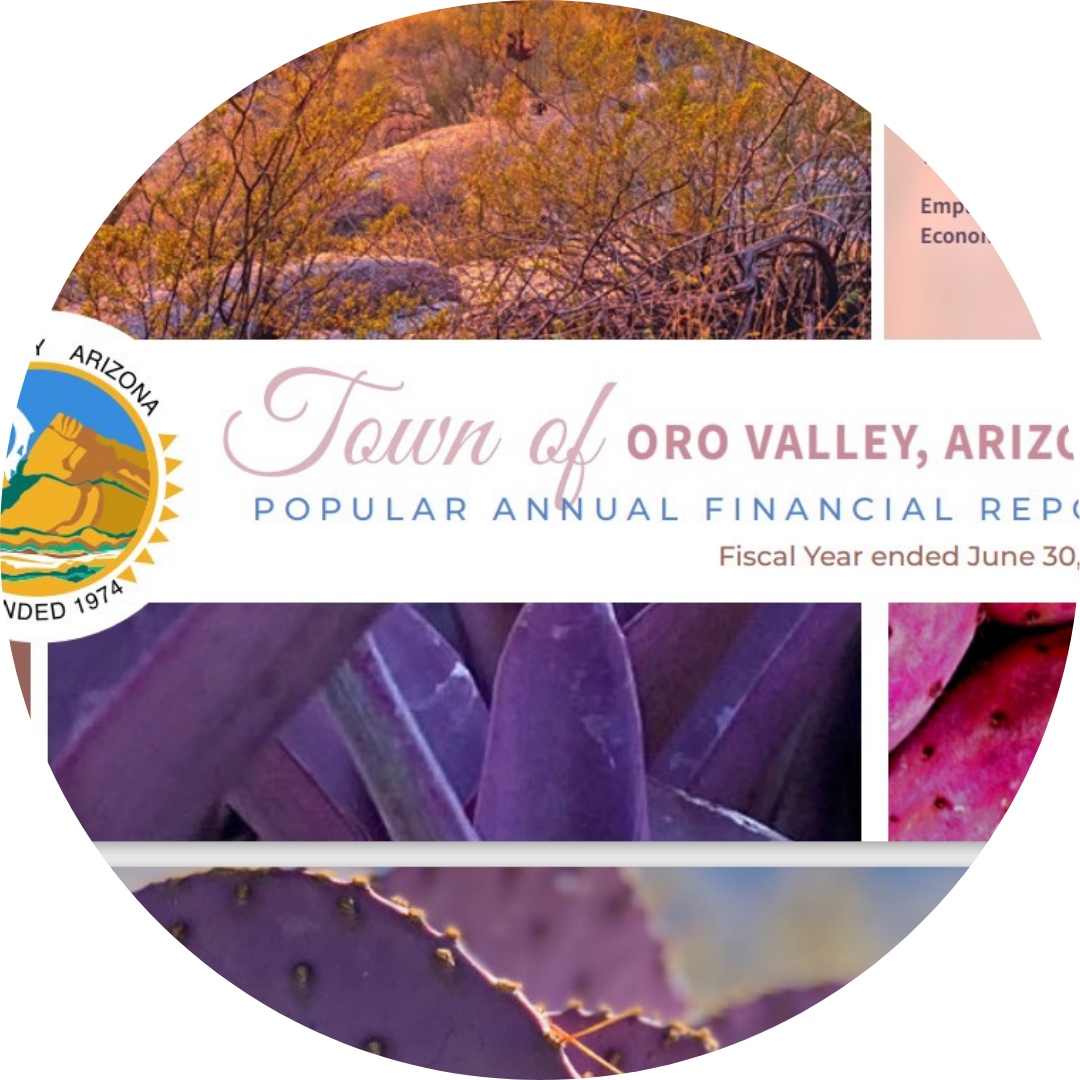
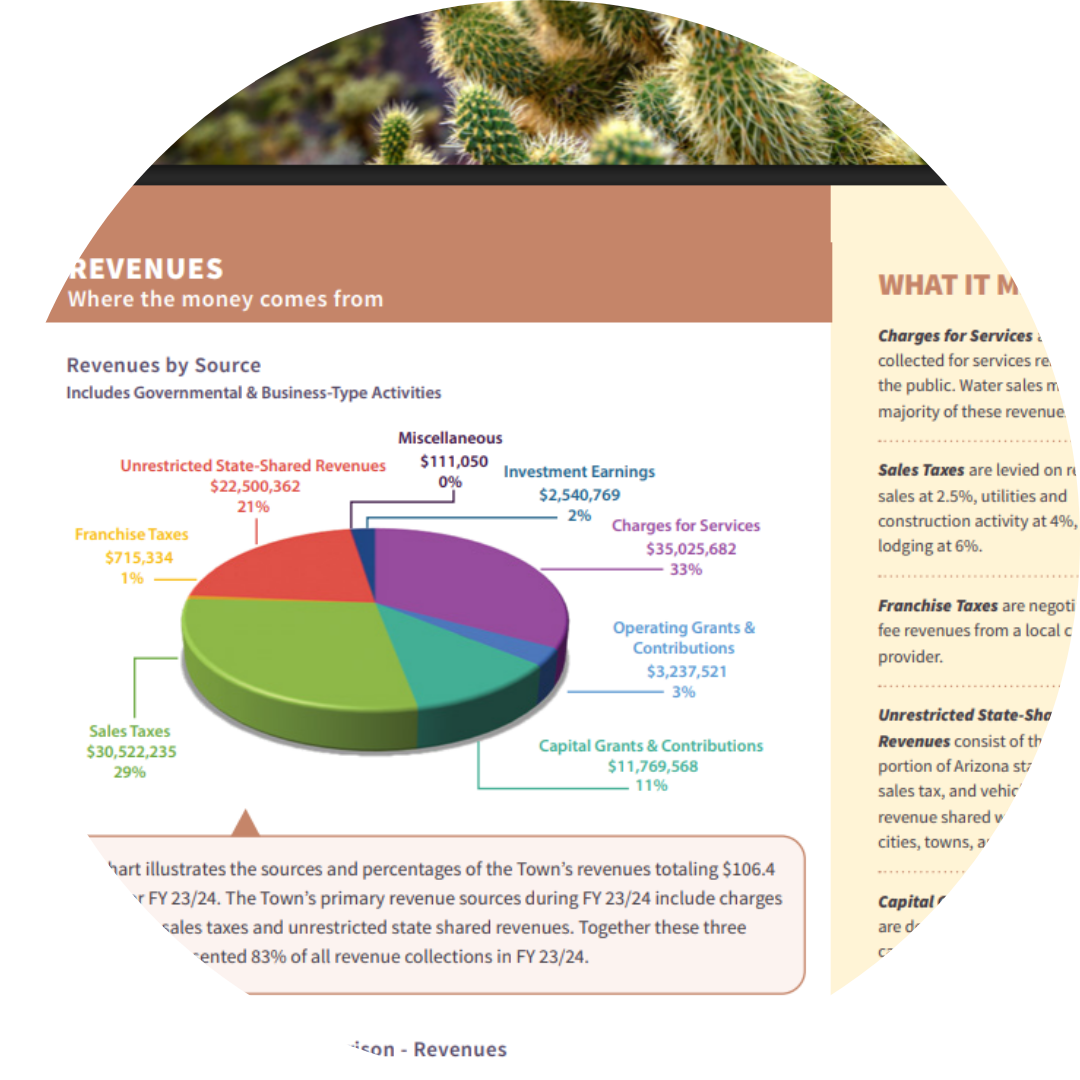
Produce and distribute financial reports on a timely basis (monthly, quarterly, and annually) that provide comprehensive information at various levels of financial literacy, such as the Popular Financial Report and Know Your Town’s Budget.
Finance
The following actions are anticipated for completion in 1-2 years:
Departments
189
Add more financial details, including a schedule of publications, to the Town’s website.
Finance
The following actions are anticipated for completion in 3-6 years:
Departments
190
Explore tools to increase transparency of revenue and expenditures.
Finance
Policy T.3. Routinely conduct financial studies and assessments to increase efficiency and effectiveness.
The following actions will be implemented on an ongoing basis:
Departments
191
Routinely review Town processes, project management practices, and contracts for inefficiencies.
Town Manager’s Office
192
Research best practices of similar cities for possible new revenue generators.
Finance
193
Conduct an analysis to evaluate the projected costs and benefits to the community for major Capital Improvement Projects (CIP). The financial evaluation is to be considered with the overall community benefit and need.
Finance
The following actions are anticipated for completion in 1-2 years:
Departments
194
Establish a schedule to periodically review all fees for potential increases.
Finance
Policy T.4. Prioritize budget allocations that maintain Oro Valley’s core services and benefit the community as a whole.
The following actions will be implemented on an ongoing basis:
Departments
195
Ensure adequate funding is consistently available for core services, which are safety, streets, water, parks, and community facilities.
Finance
196
Evaluate Town projects with the following emphasis:
Significant safety and infrastructure needs.
Enhancement of the quality of life for the majority of residents.
Balanced distribution geographically, specifically for Parks and Recreation projects.
Long-term financial sustainability.
Town Manager’s Office
197
Make strategic public investments that maintain OV’s quality of life and support desirable economic development.
Town Manager’s Office
198
Coordinate projects with outside agencies, including utility providers, to minimize long-term costs and construction impacts to the community.
Public Works
199
Leverage the Town’s participation in local, regional, state, and federal planning initiatives to secure funding and expand revenue sources for short- and long-term improvements, adapting to ever-changing community and market dynamics. This includes but is not limited to participating with the following groups:
Pima Association of Governments
Regional Transportation Authority
Pima County housing efforts
State of Arizona
Town Manager’s Office
Policy T.5. Encourage process improvements throughout all Town departments.
The following actions will be implemented on an ongoing basis:
Departments
200
Routinely review Town processes and project management tools for opportunities to increase efficiency and optimize performance.
Town Manager’s Office
201
Periodically review and explore the use of technology, systems, and IT infrastructure to address needs and increase efficiency.
Innovation and Technology
202
Routinely review procurement procedures and contracts to reduce costs.
Town Manager’s Office
Policy T.6. Engage the community about alternative and ongoing revenue sources.
The following actions will be implemented on an ongoing basis:
Departments
203
Utilize a variety of tools and methods, such as surveys, online and in-person community engagement regarding revenue sources (bonds, sales tax, user fees) by:
Educating the community about existing and potential revenue sources, especially the importance of local sales tax generation.
Identifying the need for new revenue or adjustments to levels of service and offerings.
Considering community feedback in recommendations, as appropriate.
Finance
Anticipated Timeframes for Completion:
Ongoing. Actions that are continually maintained.
Annual. Actions that are implemented on a yearly basis.
Short (1-2 years). Actions that have been started or require minimal resources.
Medium (3-6 years). Actions that require additional resources or time to complete.
Long (7-10 years). Actions that require additional guidance, time, and resources to complete.
The plan is currently being refined.
If you are viewing this website on a mobile device, please use full-screen mode (landscape).
Ensure sustainable revenue sources, funding, and efficient allocation of resources to provide high-quality, well-maintained, and reliable Town assets and services.
Goal.
The desired result or the envisioned future, answering the question “What do we strive for?”
Policy.
The direction or path, answering the question “How are we achieving our goals?”
Action.
The specific and measurable steps, answering the question “What steps do we need to take to achieve our goals?”
Each action includes a timeframe for completion and assigns a responsible department within the Town of Oro Valley to lead its implementation. This information is meant to be somewhat flexible, as priorities for each action may shift based on new guidance and resources. More information about the anticipated timeframe is provided at the bottom of this page.
The following is a list of policies and actions that support the goal and long-term vision for the community.
Policy T.1. Adhere to budgeting practices that prioritize planning for long-term financial obligations related to public services and amenities.
The following actions will be implemented on an ongoing basis:
Departments
186
Periodically review and update the Town’s fiscal management policies and practices to produce sound budget reports.
Finance
187
Continue to evaluate the minimum percentage for general fund reserves to make sure it is adequate and in compliance with Town financial policies.
Finance
Policy T.2. Regularly report on financial performance and increase engagement with the community in the budgeting process.
The following actions will be implemented on an ongoing basis:
Departments
188
Produce and distribute financial reports on a timely basis (monthly, quarterly, and annually) that provide comprehensive information at various levels of financial literacy, such as the Popular Financial Report and Know Your Town’s Budget.
Finance
The following actions are anticipated for completion in 1-2 years:
Departments
189
Add more financial details, including a schedule of publications, to the Town’s website.
Finance
The following actions are anticipated for completion in 3-6 years:
Departments
190
Explore tools to increase transparency of revenue and expenditures.
Finance
Policy T.3. Routinely conduct financial studies and assessments to increase efficiency and effectiveness.
The following actions will be implemented on an ongoing basis:
Departments
191
Routinely review Town processes, project management practices, and contracts for inefficiencies.
Town Manager’s Office
192
Research best practices of similar cities for possible new revenue generators.
Finance
193
Conduct an analysis to evaluate the projected costs and benefits to the community for major Capital Improvement Projects (CIP). The financial evaluation is to be considered with the overall community benefit and need.
Finance
The following actions are anticipated for completion in 1-2 years:
Departments
194
Establish a schedule to periodically review all fees for potential increases.
Finance
Policy T.4. Prioritize budget allocations that maintain Oro Valley’s core services and benefit the community as a whole.
The following actions will be implemented on an ongoing basis:
Departments
195
Ensure adequate funding is consistently available for core services, which are safety, streets, water, parks, and community facilities.
Finance
196
Evaluate Town projects with the following emphasis:
Significant safety and infrastructure needs.
Enhancement of the quality of life for the majority of residents.
Balanced distribution geographically, specifically for Parks and Recreation projects.
Long-term financial sustainability.
Town Manager’s Office
197
Make strategic public investments that maintain OV’s quality of life and support desirable economic development.
Town Manager’s Office
198
Coordinate projects with outside agencies, including utility providers, to minimize long-term costs and construction impacts to the community.
Public Works
199
Leverage the Town’s participation in local, regional, state, and federal planning initiatives to secure funding and expand revenue sources for short- and long-term improvements, adapting to ever-changing community and market dynamics. This includes but is not limited to participating with the following groups:
Pima Association of Governments
Regional Transportation Authority
Pima County housing efforts
State of Arizona
Town Manager’s Office
Policy T.5. Encourage process improvements throughout all Town departments.
The following actions will be implemented on an ongoing basis:
Departments
200
Routinely review Town processes and project management tools for opportunities to increase efficiency and optimize performance.
Town Manager’s Office
201
Periodically review and explore the use of technology, systems, and IT infrastructure to address needs and increase efficiency.
Innovation and Technology
202
Routinely review procurement procedures and contracts to reduce costs.
Town Manager’s Office
Policy T.6. Engage the community about alternative and ongoing revenue sources.
The following actions will be implemented on an ongoing basis:
Departments
203
Utilize a variety of tools and methods, such as surveys, online and in-person community engagement regarding revenue sources (bonds, sales tax, user fees) by:
Educating the community about existing and potential revenue sources, especially the importance of local sales tax generation.
Identifying the need for new revenue or adjustments to levels of service and offerings.
Considering community feedback in recommendations, as appropriate.
Finance
Anticipated Timeframes for Completion:
Ongoing. Actions that are continually maintained.
Annual. Actions that are implemented on a yearly basis.
Short (1-2 years). Actions that have been started or require minimal resources.
Medium (3-6 years). Actions that require additional resources or time to complete.
Long (7-10 years). Actions that require additional guidance, time, and resources to complete.
Share Please provide your questions or comments about the information on this page below. on FacebookShare Please provide your questions or comments about the information on this page below. on TwitterShare Please provide your questions or comments about the information on this page below. on LinkedinEmail Please provide your questions or comments about the information on this page below. link